
 Snug Points
 Spring Collection






Most of us use a car air freshener without thinking twice. It’s a small detail – something that makes driving feel more pleasant, more personal.
But if you’ve ever experienced headaches, overpowering scents, or that artificial “chemical” smell, you’ve probably wondered:
What am I actually breathing in?
The truth is, many conventional car air fresheners contain undisclosed ingredients hidden behind vague terms like “fragrance” or even misleading scent descriptions.
This guide will help you cut through the noise and choose a car air freshener that’s genuinely safer, more transparent, and better suited to your wellbeing.
Table of Contents
What Does “Non-Toxic” Actually Mean?
The term “non-toxic” is widely used – but rarely defined.
In the fragrance industry, there’s no single, strict standard that all brands must follow. This means products can be labelled “non-toxic” without clear evidence or full transparency.
So instead of relying on marketing terms, it helps to set a practical baseline.
At Snug Scent, we define a non-toxic car air freshener as one that:
- Uses ingredients KNOWN TO BE SAFE for human exposure (based on available data)
- Avoids known endocrine disruptors
- Does not release harmful levels of VOCs (volatile organic compounds)
- Provides transparent, traceable ingredient information
In simple terms, if something hasn’t been properly tested or disclosed, we don’t consider it truly non-toxic.
The Hidden Problem with “Fragrance”, “Parfum” or “… With Essential Oils”
When you see “fragrance” or “parfum” on a label, it might sound harmless – but it can represent a complex mixture of many different chemicals.
In many cases:
- These ingredients are not fully disclosed
- Some may not be thoroughly tested for long-term exposure
- The exact composition is protected as a trade secret
This lack of transparency makes it difficult to know what you’re actually inhaling – especially in a small, enclosed space like your car.

Historically, we’ve seen similar patterns where ingredients, due to the lack of testing, have been widely used:
- Lilial and Lyral are synthetic fragrance compounds formerly popular in cosmetics and fragrances for their lily-of-the-valley (muguet) scent. These are now banned in the EU, UK, and several other regions due to significant health concerns
- Substances once considered safe (like asbestos or cigarettes) were later found to be harmful
And more recently (September 1, 2025):
- Certain ingredients in nail polish and gel products – once commonly used – have come under scrutiny only after wider, long-term exposure and improved testing
The issue wasn’t immediate danger – it was a lack of long-term data.
I think it’s safe to say: unknown doesn’t automatically mean safe.
The challenge with “fragrance” is not just what we know – it’s what we don’t.
- It can contain multiple undisclosed compounds
- Not all combinations are thoroughly studied over long-term, repeated exposure, or studied at all (applies to compounds)
- Especially not in confined environments like cars
Instead of relying on generic terms like “fragrance”, it’s more reassuring to choose products where:
- Ingredients are clearly listed
- Components are well understood
- Transparency is prioritised over secrecy
What about products labelled “with essential oils”?
You may also come across products marketed as:
- “Made with essential oils”
- “Infused with essential oils”
At first glance, this sounds like a safer, more natural option.
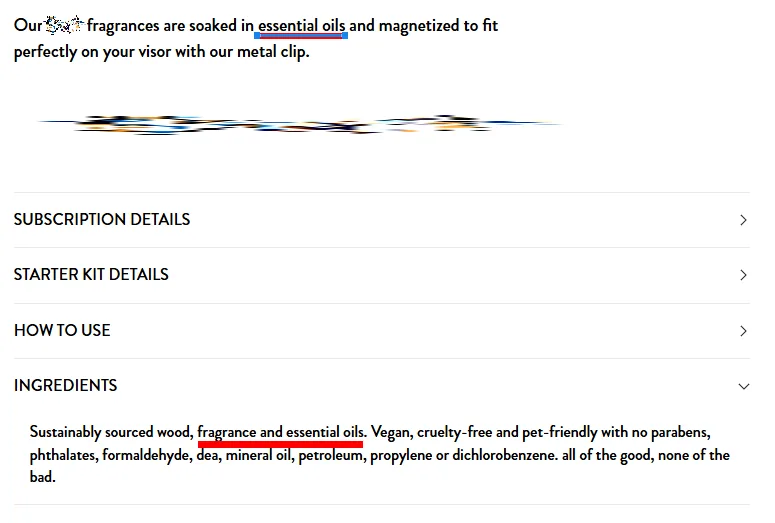
But in many cases, these products still contain synthetic fragrance blends alongside small amounts of essential oils. This practice is called “cleanwashing“.
Example of cleanwashing when “essential oils” is instantly visible, but fragrances are hidden behind a dropdown menu:
Why this can be misleading?
Adding a small amount of essential oil doesn’t change the overall composition if the product is still primarily made up of undisclosed fragrance chemicals.
In simple terms, adding something natural doesn’t cancel out what’s not.
Or put another way:
You can’t make something truly clean just by blending in a small amount of something natural.
What to look for instead?
If you’re aiming for a genuinely safer option, look for products that are:
- Made with 100% essential oils (not “with” or “infused”)
- Free from synthetic fragrance blends
- Fully transparent about every ingredient used
Are “Scent Notes” Hiding the Real Ingredients?
You’ve probably seen car air fresheners described with terms like:
- Apple
- Vanilla
- Fresh linen
- Coconut
- Amber
Or structured as:
- Top notes
- Heart notes
- Base notes
These sound descriptive – but they can also be misleading.
Notes describe smell, not ingredients
Scent notes are used to explain how a fragrance smells – not what it contains.
“Apple” is not an ingredient – it’s a scent profile.
There is no single “apple molecule”. That familiar apple scent is created using a blend of multiple compounds – often synthetic.
Why this matters
- It creates a false sense of transparency
- Consumers may assume the product contains natural extracts
- In reality, it’s often a lab-created interpretation
Think of it like food:
Saying something smells like “apple” is similar to saying something tastes like “strawberry” – without telling you whether it comes from real fruit or artificial flavouring.
Key takeaway
Scent descriptions:
- Tell you how something smells
- Don’t tell you what you’re breathing in
Why Synthetic Car Air Fresheners May Affect Your Health
Your car is a small, enclosed environment, which makes exposure more concentrated than in larger spaces.
Some conventional air fresheners may release:
- VOCs (volatile organic compounds)
- Irritants that affect breathing
- Compounds linked to headaches or nausea
- Potential endocrine disruptors
For people who are:
- Sensitive to fragrances
- Prone to headaches
- Concerned about long-term exposure
…this can make a noticeable difference.
Are Essential Oil Car Air Fresheners Safer?
Essential oil-based car air fresheners are often seen as a safer alternative – and in many cases, they can be.
Why essential oils are different? Well…
- Their composition is well studied and understood
- They’ve been used for centuries
- They offer greater transparency compared to synthetic blends
But natural doesn’t automatically mean risk-free.
- Essential oils are still made up of chemical compounds
- Some may cause irritation if used incorrectly
- Proper formulation and dosage matter
This is where expertise becomes important – especially when blending oils for use in small spaces like cars.
How to Choose a Truly Safe Car Air Freshener
If you want a safer option, here’s what to look for:
- Full Ingredient Transparency – Avoid vague terms like “fragrance” or “parfum”
- No Synthetic Fragrance Oils – Look for products made with 100% essential oils
- Plant-Based or Natural Carrier – Avoid petroleum-derived bases where possible
- Low VOC Emissions – Especially important in enclosed spaces like cars
- Reusable & Sustainable Design – Better for both your health and the environment
- Clear Safety Guidance – Especially important for families traveling with pets or children
- CLP Compliance & Safety Information – A key sign of a responsible, transparent brand
CLP Compliance & Safety Information for car fragrances
This is a big one, so we’ll explain in a separate section. 🙂
CLP stands for Classification, Labelling and Packaging Regulation – a UK/EU legal framework designed to ensure consumers are properly informed about chemical safety.
What many people don’t realise – CLP requirements don’t only apply to the physical product label.
THEY ALSO APPLY TO ONLINE SALES.
If a car air freshener is sold online, the website (including the product page) must provide relevant safety information before purchase.
What You Should Expect to See on a Product Page
A compliant and transparent brand should clearly display:
- Hazard statements (H-phrases)
- Precautionary statements (P-phrases)
- Allergen disclosure (e.g. limonene, linalool)
- Product identifiers
- Seller details
- Mentions of MSDS or SDS
This ensures you can make an informed and safe decision before buying.
Here is how we disclose the required information:


Why This Matters?
If this information is missing from a product page:
- The product may not meet regulatory requirements
- It raises questions about whether it has been properly assessed and classified
- It limits your ability to:
- Identify allergens
- Understand safe usage
- Make an informed choice
A Simple way to think about it – Transparency isn’t optional – it’s a legal requirement.
So if a brand:
- Talks about being “non-toxic” or “safe”
- But doesn’t provide CLP information online
That’s not a sign of simplicity – it’s a lack of compliance and transparency
Why Safety Labels Don’t Mean a Product Is Harmful
Seeing warnings or unfamiliar chemical names on a label can feel concerning – but context matters.
Hazard vs Risk
- Hazard = potential to cause harm
- Risk = likelihood of harm during normal use
For example:
- Essential oils naturally contain allergens like limonene
- These must be listed under regulations
But:
- When used in controlled amounts
- And as intended
The actual risk remains low for most people.
What a proper label really tells you
A compliant label means:
- The product has been assessed for safety
- Ingredients are fully disclosed where required
- You’re given clear guidance for safe use
This is a sign of transparency – not danger
The real red flag
If a product claims to be:
- “Non-toxic”
- “Natural”
…but provides no safety information at all. That’s when to be cautious!
A Better Approach: Simple, Transparent Fragrance
When it comes to car air fresheners, simpler is often better.
Products made with:
- Clearly listed ingredients
- Essential oil-based blends
- Plant-based carriers
…offer a more transparent and considered approach to fragrance.
Brands that prioritise:
- Ingredient clarity
- Small-batch production
- Thoughtful formulation
help you make more informed choices about what you’re breathing in every day
Final Thoughts: Safer Air Starts with Better Choices
You don’t need to stop using car air fresheners to create a healthier environment.
Instead, focus on choosing products that are:
- Transparent about their ingredients
- Based on well-understood materials
- Designed with safety in mind
Because in a space as small and personal as your car, what you breathe in matters more than you think.
